Dmail specified a 200 million DMAIL cap for its token supply
Dmail specified a maximum supply of 200 million DMAIL tokens for its Web3 messaging network. That ceiling defined the token design’s upper limit; it did not establish how many tokens circulated at a particular time. Allocation percentages used this full pool, while market capitalization required a circulating quantity and a token price from the same measurement period. In April 2026, the project announced a service shutdown beginning May 15, 2026, which changed the context for its listed token uses. The cap could not establish the funds available for email infrastructure or the demand for network services.
Updated on
The short version: The 200 million DMAIL cap described token quantity, while the non-refundable utility design gave holders no promised redemption value.
The 200 million cap described the upper supply limit
200,000,000 DMAIL was the maximum supply specified for the network’s governance and utility token, expressed in whole token units. This figure provided the denominator for the allocation plan. A category’s allocation equaled its percentage multiplied by 200,000,000. The resulting amount described that category’s share of the planned pool. It did not establish a balance available to trade, an amount received by one participant, or a quantity already released.
Supply categories used DMAIL units with different boundaries
Maximum, total, and circulating supply described different quantities, even though all three used DMAIL tokens as their unit of measurement.
Total and circulating supply
Maximum supply described the ceiling, while total supply described existing tokens under the relevant accounting rules. Circulating supply counted the portion that a measurement method treated as publicly circulating. The token plan also labeled its full 200 million pool as total supply. That label did not provide a dated circulating measurement. Locked allocations and reserves could affect the relationship between these quantities, so the allocation plan could not substitute for a circulation figure at a particular date.
Ethereum and BNB Chain
The token design identified Ethereum issuance under ERC-20 and BNB Chain issuance under BEP-20. These standards described token interfaces on their respective networks. The same design specified one 200 million maximum for DMAIL; it did not assign a separate 200 million allowance to each chain. A combined supply calculation would need the accounting relationship between network representations. The chain labels alone could not establish a combined circulating quantity.
Allocation percentages divided the full token pool
The distribution plan divided the 200,000,000-token pool into categories whose percentages added to 100%, with amounts expressed in DMAIL.
Investors, the team, and the treasury
Investors accounted for 17%, or 34,000,000 tokens. Core team members and advisers accounted for 15%, or 30,000,000 tokens. The Foundation and Treasury category represented another 15%, also 30,000,000 tokens. These were planned category allocations. The percentages did not identify each recipient’s balance or establish the amount that recipients could access at a particular time.
Community and airdrop categories
The distribution plan allocated 76,000,000 DMAIL to the Community category. This represented 38% of the full pool. Airdrop Season 1 accounted for 3.75%, or 7,500,000 tokens, while Airdrop Season 2 accounted for 2.25%, or 4,500,000 tokens. The Community allocation and the two named airdrop seasons occupied separate categories.
Ecosystem development and exchange events
Ecosystem Development accounted for 6%, or 12,000,000 tokens. Centralized exchange events accounted for 3%, or 6,000,000 tokens. Community, both airdrop seasons, and ecosystem development together added to 50% of the planned pool. That grouping amounted to 100,000,000 DMAIL spread across distinct allocation categories.
Release conditions affected the available supply
An allocation assigned tokens to a category, while any applicable release restrictions governed when recipients could access those tokens. Vesting referred to the conditions under which an entitlement became available. An unlock removed a restriction, but a circulating-supply measurement still needed its own treatment of reserves and other excluded balances. A category’s full allocation therefore could not establish how much of that allocation circulated on a given date.
The supply plan’s category percentages carried no timestamp for actual circulation. A dated supply comparison needed quantities from the same period and consistent accounting boundaries. Changes in a measured circulating balance could alter valuation calculations even when the documented maximum remained unchanged.
Market capitalization depended on the selected supply quantity
Market capitalization multiplied circulating DMAIL by price per token; a maximum-supply fully diluted valuation multiplied the 200 million ceiling by price. Both calculations expressed a monetary value, although their supply inputs answered different questions. The maximum-supply calculation valued the full planned token quantity at the selected price. It did not measure the project’s treasury or the proceeds that holders could obtain from selling their balances.
Changing circulation changed the calculated market capitalization
Consider a hypothetical comparison with circulating supplies of 84,375,215 and 94,375,215 DMAIL, both priced at $0.0037 per token. Both circulating quantities and the price are invented inputs. The 200,000,000 DMAIL maximum follows the token design.
Multiplying 84,375,215 by $0.0037 gives a calculated market capitalization of $312,188.30, rounded to cents. Multiplying 94,375,215 by the same price gives $349,188.30. The larger circulating quantity increases the calculation by $37,000. In both cases, multiplying the 200,000,000 maximum by $0.0037 gives a maximum-supply fully diluted valuation of $740,000.
The circulation input changed one valuation without changing the other. These figures describe the comparison’s arithmetic, not an observed token price, a current market capitalization, or cash available to holders.
Changing the price would change both valuations. A current calculation would require a relevant market price and a dated circulating figure; the historical supply ceiling could supply only the maximum-quantity input.
The token’s designed uses differed from those of mailbox points
DMAIL’s intended roles included governance voting, transaction and NFT trading fees, contributor incentives, and staking to operate relay nodes. The token plan included task-point holders and advertisement recipients among its incentive groups. These uses described the network’s economic design. The supply cap counted token units across that design, without setting a payment rate for every service or an award for every activity.
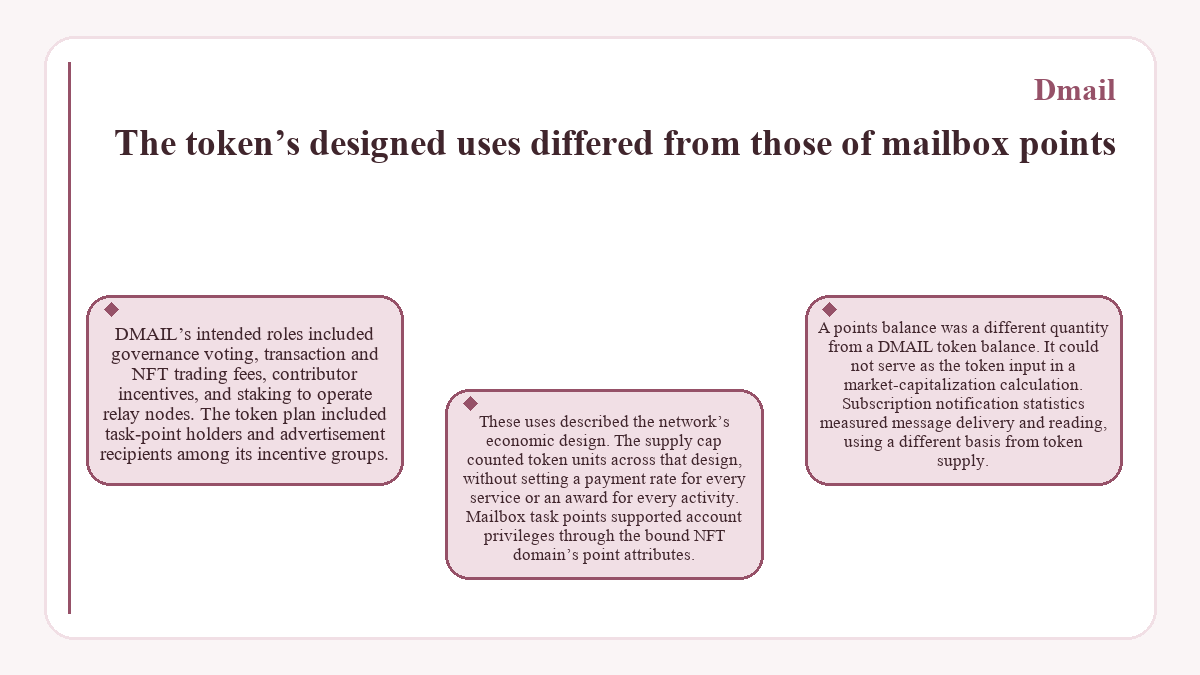
Mailbox task points supported account privileges through the bound NFT domain’s point attributes. A points balance was a different quantity from a DMAIL token balance. It could not serve as the token input in a market-capitalization calculation. Subscription notification statistics measured message delivery and reading, using a different basis from token supply.
The announced shutdown changed the utility context
The April 2026 announcement set May 15, 2026, as the start of the shutdown and asked users to export their email beforehand. The team cited expensive bandwidth, storage, and computing, alongside unsuccessful paid models and token economics that had failed to support sustainable operations. Those operating problems affected the services behind the token’s intended uses.
The team expressed a hope of relaunching in a more mature form if future conditions allowed it. That hope supplied no assured return of the earlier services. A relaunched network with defined token functions would change the utility assessment, even if its maximum supply remained 200 million DMAIL.
Dmail: what people ask
What did the dollar sign in $DMAIL mean for the supply figure?
The dollar sign marked the token ticker and did not assign a dollar value to each token. The 200 million figure counted DMAIL units. A price quoted in dollars expressed money per token, which was a separate input. Treating the ticker’s dollar sign as a price would confuse token quantity with monetary value.
Is the published cap enough to establish an immutable minting limit?
The published cap alone did not establish an immutable limit in deployed code. That property depended on the contract’s issuance rules and any authority to change them. ERC-20 defines a token interface without mandating a fixed supply ceiling. The 200 million statement therefore described the supply design without proving that contract permissions could never alter issuance.
Were ecosystem development and the airdrop seasons the same allocation?
Ecosystem development and the two airdrop seasons occupied separate allocation categories. Ecosystem Development accounted for 12,000,000 DMAIL. Airdrop Season 1 and Airdrop Season 2 together also accounted for 12,000,000 DMAIL, because 3.75% plus 2.25% equaled 6% of the planned supply. Equal totals did not make these categories interchangeable or duplicate entries.
Did the supply cap determine the mailbox’s daily email allowance?
The mailbox’s account tier governed its daily email allowance, independently of the token supply ceiling. The DApp linked tiers to the actively bound NFT domain and imported points. Tier privileges included daily sending limits and encrypted storage space. The 200 million DMAIL quantity could not be converted into an email quota or a storage allowance.
How did the Season 1 allocation relate to an individual airdrop award?
The 3.75% share applied to the entire Airdrop Season 1 allocation. It represented 7,500,000 DMAIL within the full planned pool. An individual award depended on the program’s distribution rules and eligibility conditions. The aggregate percentage did not establish how many tokens a particular participant received or turn the whole pool into that participant’s entitlement.
Was DMAIL refundable because it had a capped supply?
DMAIL’s design described it as a non-refundable functional utility token. The 200 million ceiling created no redemption entitlement or fixed reimbursement amount. A valuation calculated from a token price was different from an issuer’s obligation to repay a holder. The supply quantity therefore could not establish a refund payment following the announced shutdown.
Could allocation percentages show how concentrated DMAIL ownership was?
Allocation percentages described planned category shares without establishing actual ownership concentration. A concentration measure required dated holder balances and a meaningful definition of a holder. Investor, team, and Community categories did not specify each recipient’s holding. A category total could therefore describe a large allocation without identifying the amount that any single recipient controlled.